Wednesday, September 17, 2014

Review: Mammut Tusk 9.8mm Climbing Rope


Review: Mammut Tusk 9.8mm Climbing Rope

The Mammut Tusk 9.8mm rope is a classic workhorse rope from one of the most trusted names in climbing. Mammut has been around for over 50 years and has been the leader in climbing ropes for as long as we can remember. Their reputation goes a long way, but how good are their ropes?


Mammut Tusk 9.8mm getting ready for some action.
We got our hands on Mammut's Tusk 9.8mm climbing rope and it took it out for an afternoon of abuse. The Tusk is a 70m single pattern dynamic climbing rope. Designed as a sport and gym rope, the rope has a moderate amount of stretch and is rated to withstand significant falls. Unlike standard dry treated ropes that only have a treated sheath, Mammut's SuperDry technology is a coating for both the sheath and the core, keeping your rope cleaner and drier than the average rope. 

The following triptych named "Joe Didn't Die":


The rope performed admirably in our testing. Like most new ropes, it has a slippery, waxy feel to it that makes it feel like you're driving a new car. It doesn't kink or knot out of the bag. In fact, it is an absolute pleasure to flake, maintain, and use. It folds and coils neatly and doesn't knot up when you're belaying. 

The Hot:

The Mammut Tusk Climbing Rope - 9.8mm is a beast. It's burly rope made for taking a bunch of abuse and still keeping you safe. At RI, we love products that are designed to take abuse. The Tusk feels substantial in your hand. It feels like it'll take a few whips. We like that.

The Not:

We don't have much bad to say about this rope. The price is what you would expect from an industry-leading brand, but for almost $250, we really would love a bipattern on the sheath. Rope manufacturers realize this is a "premium" feature and have been using it as an upsell for long enough. 

The Bottom Line:

The Mammut Tusk Climbing Rope - 9.8mm ($239.95 for the 70 meter version on Amazon) is a workhorse rope. It's not light, but neither is a Ford F-150. The Tusk is strong, high-performance, and durable. There are ropes from lesser manufacturers with similar stats and a lower price, but Mammut is one of the most trusted names in rock climbing and alpinism. They've been the leading name in ropes for decades with good reason. The price is on the higher side, but if you can afford it, we highly suggest you pony up. Mammut makes superior ropes, and the Tusk is a sturdy, well-built rope that will last you for years and keep you safe through many a whipper.

Be safe,

Ariel M. Castro
Rugged Innovations

Monday, September 1, 2014

Review: Black Diamond Spot Headlamp

Review: Black Diamond Spot Headlamp

Black Diamond Spot Headlamp next to a fire
Black Diamond Spot Headlamp
A headlamp is an absolute necessity in a climber's kit. It's one of those gadgets that you don't need at all... until you do. And when you do it's usually a sketchball situation where you're glad you have the headlamp. Our team had just such an experience lately and were fortunate enough to have a Black Diamond Spot Headlamp ($29.95 on Amazon) for the job.

Team RI was doing a leisurely 7 pitch trad route at First Creek Slabs with a team of four just outside of Red Rocks Canyon in Las Vegas -- It was supposed to be a quick day trip. A three hour touuur.... Lady Luck (5.7) is a great moderate slab haul with a huge variety of climbing: big hollow huecos, forgiving slab with balancey moves, some exposed arete areas, a couple of juicy fist crack sections, and basically everything you'd want out of an afternoon of moderate multipitch climbing. The descent, on the other hand, was a total bear. We ended up getting lost and rapping in the dark. You probably saw that coming.

Enter the hero of our story, Black Diamond's Spot Headlamp. Two of us on the team had this headlamp and the other two of us had some generic crappy ones from Wal-Mart. We going to credit the Black Diamond Spot Headlamp with keeping us from ending up as hamburger meat at the bottom of a sparsely-traveled sandstone cliff. We'd like to thank all the appropriate deities and BD for keeping us safe for the umpteenth time.


Black Diamond Spot Headlamp in Red Rock Canyon
Black Diamond Spot Headlamp in action.
The lamp itself is BD's entry level device and the cheapest one they make. The 2013 model is for sale at $29.97, and it's one of the best value headlamps you'll find. Even though it's Black Diamond's lowest model, the headlamp performs better than either of the department store headlamps our team had. It's bright. We used it on our abseil fiasco and it allowed us to spot features and anchors in the pitch black of Nevada night from around 50 feet.

Since it's the entry level model, it doesn't have much in the way of features, but we're okay with that. At the end of the day, your headlamp has one job and must do it well. The Black Diamond Spot cranks out 90 lumens, which isn't as much as more expensive models, but it was plenty for pitch black rapping misadventures. Maybe if you're a kayaker or mountain biker, you might want a brighter lamp. For a climber, BD's 90 lumen light is plenty. The headlamp has several different LEDs on it, including a red one that is designed to preserve your night vision. The main light set has a fader which allows you to turn down the brightness. We could see that being useful in dusky situations or when you're trying to infiltrate an enemy compound or something. 


We totally didn't die. Thanks BD!

The hot

The BD Spot Headlamp is an affordable multi-lumen fiend from one of the most trusted names in alpine sports. It's $29 bucks. That's cheaper than a sandwich and a beer at a ski lodge. It's an incredibly high-value head lamp with great performance and a long battery life. 


The not

It's hard to find any gripes about it. It's a stripped down lamp without many features. It doesn't have rechargeable batteries, it doesn't have an over-the-head strap, and it won't call you back after a first date. It's 90 lumens. If you can find a better lamp for the price, let us know! 

The bottom line

The Black Diamond Spot Headlamp ($29.97 on Amazon) is a little powerhouse of a lamp at a great price point. We credit it on saving our hides on multiple occasions. If you want a durable, powerful lamp for a low price, look no further. The Black Diamond Spot Headlamp is a great value and doesn't skimp on performance.


Be safe, 

Ariel Castro
Rugged Innovations

Wednesday, April 16, 2014

Review: Belay Shades Belaying Glasses

Review: Belay Shades Belaying Glasses


Today we set our steely, Eastwood-esque gazes on a really interesting product that I don't think many people have been exposed to: belay glasses. Belay glasses are pretty ingenious. They are regular glasses with the lenses replaced with upward-pointing prisms. The prisms bounce light from above you into your eyes. Your optic nerves sends the light into your brain, which interprets the light into an image of your sweaty climbing partner spending 45 minutes projecting the crux moves of a "totally sandbagged" 5.11a. C'mon dude, the sun is setting. Belay Shades are designed to protect the belayer's neck by preventing them from having to keep their head pointed up while they watch their climbing partner. It's a low-tech gadget with big benefits.

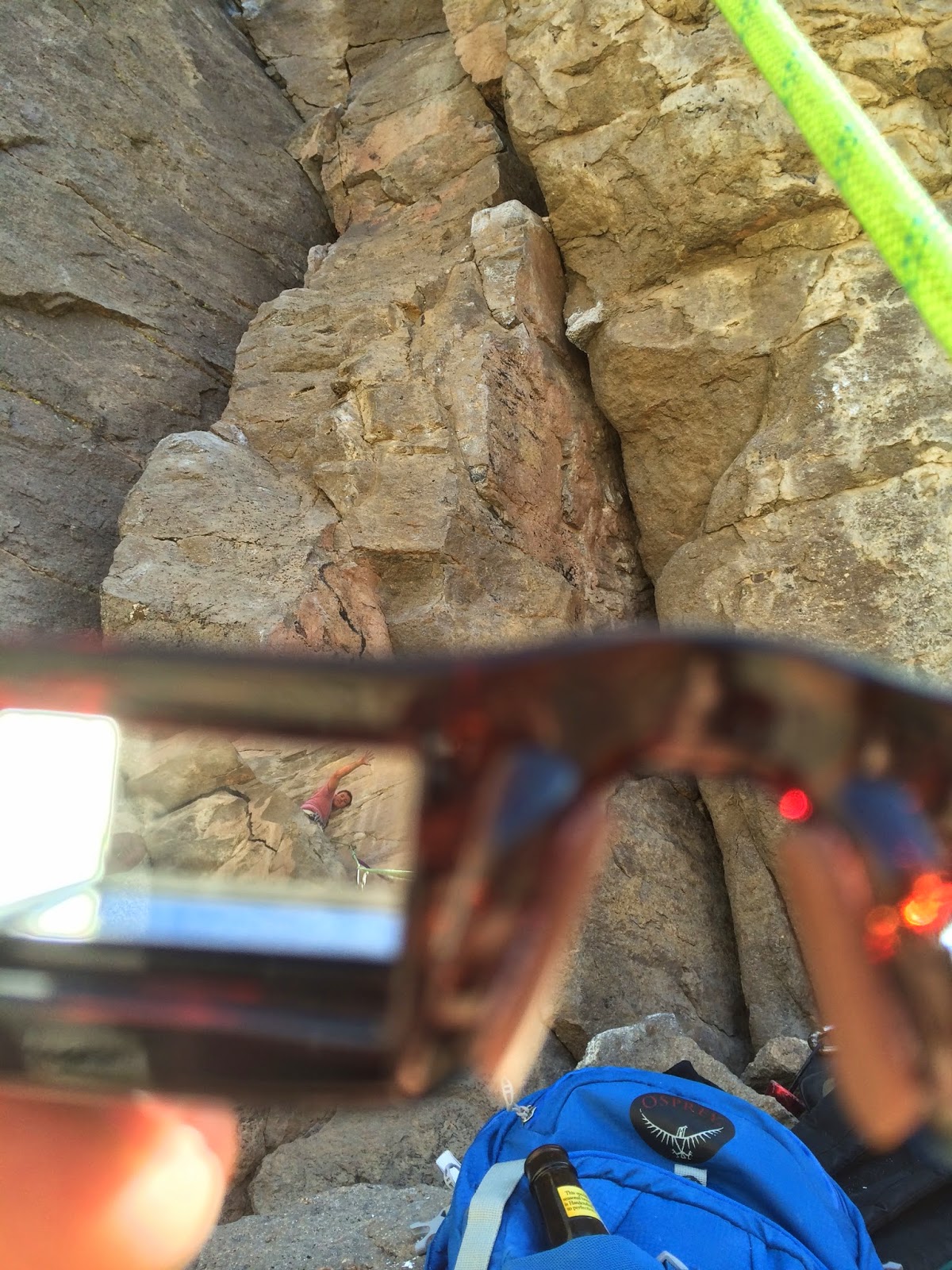
Belay Shades getting their moment in the sun. Owens River Gorge, CA.

We've been wanting to try these for the longest time and finally got our chance. Belay glasses have been around for a while in various forms. We've heard of old school climbers making homebrew pairs out of busted sunglasses and mirrors from their girlfriends' makeup kits. Belay Shades are a streamlined, evolved version of this. It's a high quality product and despite the fancy optics, pretty rugged! As you all know, we here at Rugged Innovations are decidedly unkind to gear. Why? Because we take big falls all the time, and expect our gear to be able to keep up with us. It's a reasonable expectation for high-performance gear and we push it to the limit.

Belay Shades are tough little suckers. We wore them off and on for about 5 hours in Owens River Gorge while belaying some friends. We also dropped them several times and were generally pretty irreverent with them -- it's not our job to babysit gear. They didn't scratch, scuff, bend, or break. We all gave them a whirl and loved the ability to keep our necks attached to our body during a long belay session. These guys save your neck, I'm telling you. Anyone who's belayed for an hour or more at a stretch can tell you it's brutal; by the end of it you are moving your head into all kinds of weird positions to try to use different muscles. Belay Shades 100% alleviate this issue for sport cragging. 

Objects in Belay Shades are stronger than they appear.
Belay Shades are unique for a couple of reasons. One thing we like about them is that they use prisms and not mirrors. The prisms can't bend, move, or get out of alignment with respect to your object of focus. The optics have no moving or folding parts to calibrate. Another thing we liked about Belay Shades is that they are built out of real glasses. If you look at the belay glasses made by other companies, they are constructed out of cut aluminum pieces and end up looking like Robocop's snorkeling equipment. Belay Shades are made out of glasses -- actual human glasses. Belay Shades are, in my opinion, the least dorky belay glasses on the market. No one is going to win fashion awards when they're wearing any belay glasses, but Belay Shades are the least obtrusive.

These Belay Shades are incredible for sport projecting. They completely eliminate the sore neck issue because you don't have to look up at all. You can have a clear view of your climbing partner the whole time while having a clear view of your immediate surroundings.

Having said that, there are a few considerations when wearing Belay Shades. The most obvious is that when you are wearing them, you can't see what is directly in front of you without moving your head around a bit. This makes them not necessarily appropriate for multipitch climbing where you have to keep an eye on your anchor and make small adjustments often. They also are not great to wear for really long periods of time. I got a bit dizzy after wearing them for about an hour straight on a really, really long pitch we were working. Then again, if your climbing partner is spending 60 minutes on the wall, you should probably consider getting them a sponsorship or introduce them to endurance sports.

We have to say, we love the Belay Shades ($44.98 at their site). They are exactly what you want from a pair of belay glasses and then some. They come with a cloth carrying bag, a beefy padded hard shell protective case, a cord to hang them around your neck when you're not using them, and a little microfiber cloth to wipe them down when you inevitably kick some dust up onto them. It's quite a package, but the product itself is what sells it for me. They protect your neck during long belay sessions and are, in my opinion, the best option on the market. We dropped them a few times on rock surfaces from about waist height and the lenses had nary a scuff. Verdict: rugged as heck. For serious sport climbers and single-pitch tradders, these are pretty game-changing. Once you try them, you will not want to go sport climbing without Belay Shades!

Have fun!

Ariel
Rugged Innovations