Showing posts with label Fun. Show all posts

Thursday, November 6, 2014

Review: Black Diamond Ion LED Headlamp

Review: Black Diamond Ion LED Headlamp (2014)

Today we write you from the bottom of a dark cave, surrounded by bats, wearing Black Diamond's newest iteration of their Ion headlamp. It's cold and weird down here, but visibility is high and spirits are soaring thanks to BD's new microlamp offering. The Ion headlamp was designed to be a "just-in-case" backup headlamp, boasting stripped down size and minimal features with full lumen power.


Black Diamond Ion Headlamp 2014
The Ion underwent a total overhaul from its 2013 model. The 2013 Ion model, all things considered, looks and feels like some corporate-branded swag from an industry conference. It kinda feels cheap. The brand new Black Diamond Ion Headlamp is a whole different beast.

Lightweight, stripped-down, and with brand new touch-sensor controls, the lamp is a pretty bold move on Black Diamond's part. It's the smallest headlamp we've ever seen. People call it a "micro" headlamp, and we think that's accurate. The whole lamp is not significantly bigger than the AAA batteries inside it. It's about the size of a golf ball, if you squeezed the golf ball into a rectangle shape.

The 2014 Black Diamond Ion Headlamp has a unique touch control system that is unlike any other lamp we've seen. It has several light settings on it that are all controlled by touch, instead of traditional buttons. You swipe your finger across the surface of the front of the light, and various different swipe motions have different effects.

The 80-lumen Ion has seven different light modes: white light, white strobe, white adjustable dim, red light, red strobe, red adjustable dim, and lock. All of these modes are accessible with different touch motions on the face of the lamp. The touch motions are described in detail in the Ion's instruction manual, and it will probably take you about 15 minutes to get comfortable with all of them. Without the tactile feedback of a clicky button, you have to just know the commands. Don't expect to be able to operate it with winter gloves on, by the way. 

The battery life on this headlamp is really short. We got about 12 hours of intermittent use out of it; maybe less. It's only got two AAA batteries in it, so we didn't expect it to last forever. After testing all the touch controls at home, it only lasted for one night of camping. I'd keep some spare batteries around if you plan to use it often. 

The Black Diamond Ion 2014 is a lightweight, compact emergency headlamp that will far exceed your expectations. Its performance is great for such a small lamp and its beam looks like one from a much bigger lamp. That said, don't expect to make this your full-time lamp. 


The Bottom Line

Black Diamond Ion Headlamp ($22.95 on Amazon) is a small, lightweight headlamp that functions as a backup to your full-size headlamp. It provides ample light for camp tasks or night climbing, but don't expect it to match your regular headlamp in brightness or battery life. The price is right for this little guy, though. It's small and cheap enough to carry as a spare in your camping kit for emergencies. The touch control system is innovative and intuitive once you're used to it. 

Ariel M. Castro
Rugged Innovations

Monday, September 1, 2014

Review: Black Diamond Spot Headlamp

Review: Black Diamond Spot Headlamp

Black Diamond Spot Headlamp next to a fire
Black Diamond Spot Headlamp
A headlamp is an absolute necessity in a climber's kit. It's one of those gadgets that you don't need at all... until you do. And when you do it's usually a sketchball situation where you're glad you have the headlamp. Our team had just such an experience lately and were fortunate enough to have a Black Diamond Spot Headlamp ($29.95 on Amazon) for the job.

Team RI was doing a leisurely 7 pitch trad route at First Creek Slabs with a team of four just outside of Red Rocks Canyon in Las Vegas -- It was supposed to be a quick day trip. A three hour touuur.... Lady Luck (5.7) is a great moderate slab haul with a huge variety of climbing: big hollow huecos, forgiving slab with balancey moves, some exposed arete areas, a couple of juicy fist crack sections, and basically everything you'd want out of an afternoon of moderate multipitch climbing. The descent, on the other hand, was a total bear. We ended up getting lost and rapping in the dark. You probably saw that coming.

Enter the hero of our story, Black Diamond's Spot Headlamp. Two of us on the team had this headlamp and the other two of us had some generic crappy ones from Wal-Mart. We going to credit the Black Diamond Spot Headlamp with keeping us from ending up as hamburger meat at the bottom of a sparsely-traveled sandstone cliff. We'd like to thank all the appropriate deities and BD for keeping us safe for the umpteenth time.


Black Diamond Spot Headlamp in Red Rock Canyon
Black Diamond Spot Headlamp in action.
The lamp itself is BD's entry level device and the cheapest one they make. The 2013 model is for sale at $29.97, and it's one of the best value headlamps you'll find. Even though it's Black Diamond's lowest model, the headlamp performs better than either of the department store headlamps our team had. It's bright. We used it on our abseil fiasco and it allowed us to spot features and anchors in the pitch black of Nevada night from around 50 feet.

Since it's the entry level model, it doesn't have much in the way of features, but we're okay with that. At the end of the day, your headlamp has one job and must do it well. The Black Diamond Spot cranks out 90 lumens, which isn't as much as more expensive models, but it was plenty for pitch black rapping misadventures. Maybe if you're a kayaker or mountain biker, you might want a brighter lamp. For a climber, BD's 90 lumen light is plenty. The headlamp has several different LEDs on it, including a red one that is designed to preserve your night vision. The main light set has a fader which allows you to turn down the brightness. We could see that being useful in dusky situations or when you're trying to infiltrate an enemy compound or something. 


We totally didn't die. Thanks BD!

The hot

The BD Spot Headlamp is an affordable multi-lumen fiend from one of the most trusted names in alpine sports. It's $29 bucks. That's cheaper than a sandwich and a beer at a ski lodge. It's an incredibly high-value head lamp with great performance and a long battery life. 


The not

It's hard to find any gripes about it. It's a stripped down lamp without many features. It doesn't have rechargeable batteries, it doesn't have an over-the-head strap, and it won't call you back after a first date. It's 90 lumens. If you can find a better lamp for the price, let us know! 

The bottom line

The Black Diamond Spot Headlamp ($29.97 on Amazon) is a little powerhouse of a lamp at a great price point. We credit it on saving our hides on multiple occasions. If you want a durable, powerful lamp for a low price, look no further. The Black Diamond Spot Headlamp is a great value and doesn't skimp on performance.


Be safe, 

Ariel Castro
Rugged Innovations

Wednesday, April 16, 2014

Review: Belay Shades Belaying Glasses

Review: Belay Shades Belaying Glasses


Today we set our steely, Eastwood-esque gazes on a really interesting product that I don't think many people have been exposed to: belay glasses. Belay glasses are pretty ingenious. They are regular glasses with the lenses replaced with upward-pointing prisms. The prisms bounce light from above you into your eyes. Your optic nerves sends the light into your brain, which interprets the light into an image of your sweaty climbing partner spending 45 minutes projecting the crux moves of a "totally sandbagged" 5.11a. C'mon dude, the sun is setting. Belay Shades are designed to protect the belayer's neck by preventing them from having to keep their head pointed up while they watch their climbing partner. It's a low-tech gadget with big benefits.

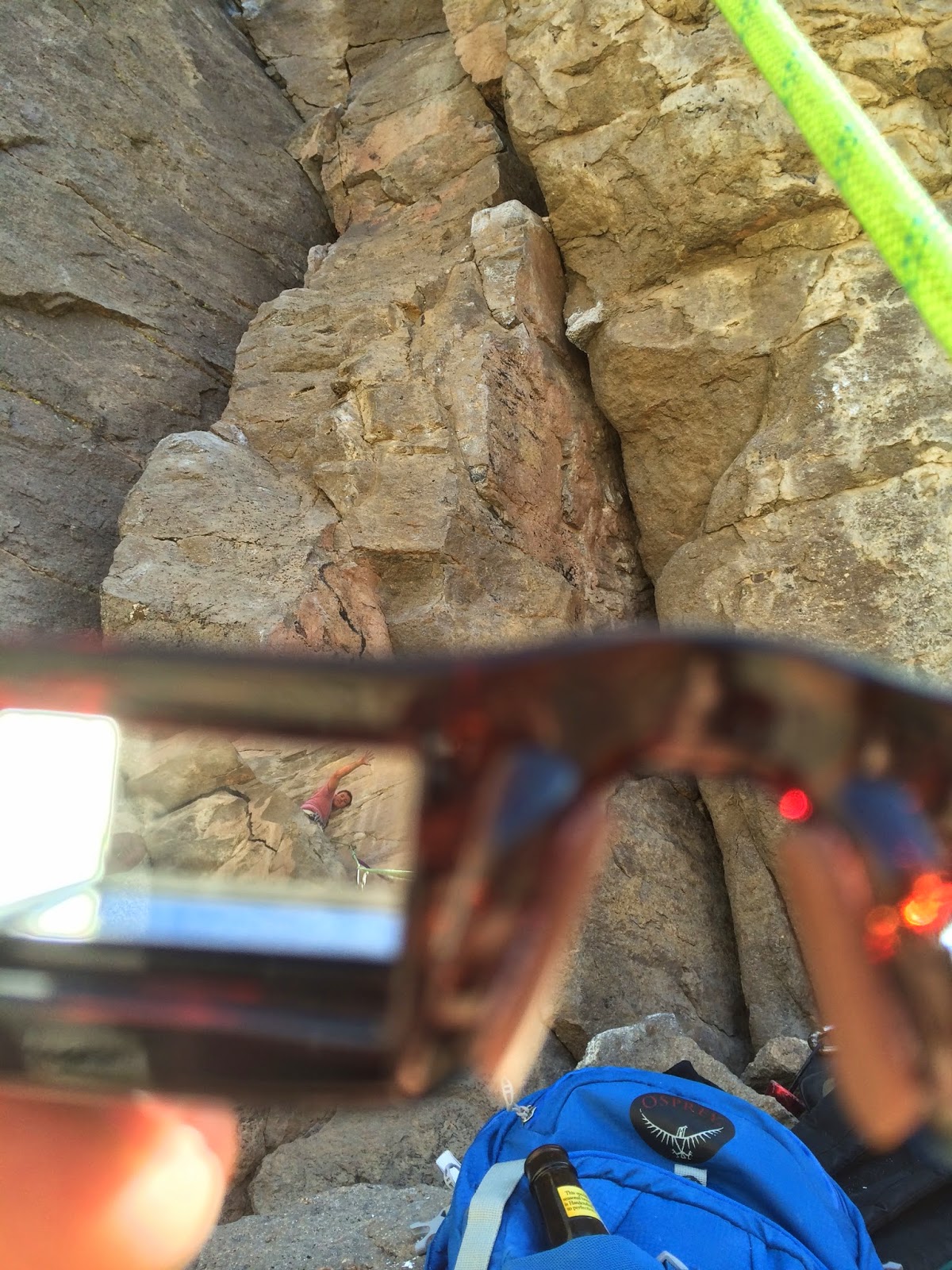
Belay Shades getting their moment in the sun. Owens River Gorge, CA.

We've been wanting to try these for the longest time and finally got our chance. Belay glasses have been around for a while in various forms. We've heard of old school climbers making homebrew pairs out of busted sunglasses and mirrors from their girlfriends' makeup kits. Belay Shades are a streamlined, evolved version of this. It's a high quality product and despite the fancy optics, pretty rugged! As you all know, we here at Rugged Innovations are decidedly unkind to gear. Why? Because we take big falls all the time, and expect our gear to be able to keep up with us. It's a reasonable expectation for high-performance gear and we push it to the limit.

Belay Shades are tough little suckers. We wore them off and on for about 5 hours in Owens River Gorge while belaying some friends. We also dropped them several times and were generally pretty irreverent with them -- it's not our job to babysit gear. They didn't scratch, scuff, bend, or break. We all gave them a whirl and loved the ability to keep our necks attached to our body during a long belay session. These guys save your neck, I'm telling you. Anyone who's belayed for an hour or more at a stretch can tell you it's brutal; by the end of it you are moving your head into all kinds of weird positions to try to use different muscles. Belay Shades 100% alleviate this issue for sport cragging. 

Objects in Belay Shades are stronger than they appear.
Belay Shades are unique for a couple of reasons. One thing we like about them is that they use prisms and not mirrors. The prisms can't bend, move, or get out of alignment with respect to your object of focus. The optics have no moving or folding parts to calibrate. Another thing we liked about Belay Shades is that they are built out of real glasses. If you look at the belay glasses made by other companies, they are constructed out of cut aluminum pieces and end up looking like Robocop's snorkeling equipment. Belay Shades are made out of glasses -- actual human glasses. Belay Shades are, in my opinion, the least dorky belay glasses on the market. No one is going to win fashion awards when they're wearing any belay glasses, but Belay Shades are the least obtrusive.

These Belay Shades are incredible for sport projecting. They completely eliminate the sore neck issue because you don't have to look up at all. You can have a clear view of your climbing partner the whole time while having a clear view of your immediate surroundings.

Having said that, there are a few considerations when wearing Belay Shades. The most obvious is that when you are wearing them, you can't see what is directly in front of you without moving your head around a bit. This makes them not necessarily appropriate for multipitch climbing where you have to keep an eye on your anchor and make small adjustments often. They also are not great to wear for really long periods of time. I got a bit dizzy after wearing them for about an hour straight on a really, really long pitch we were working. Then again, if your climbing partner is spending 60 minutes on the wall, you should probably consider getting them a sponsorship or introduce them to endurance sports.

We have to say, we love the Belay Shades ($44.98 at their site). They are exactly what you want from a pair of belay glasses and then some. They come with a cloth carrying bag, a beefy padded hard shell protective case, a cord to hang them around your neck when you're not using them, and a little microfiber cloth to wipe them down when you inevitably kick some dust up onto them. It's quite a package, but the product itself is what sells it for me. They protect your neck during long belay sessions and are, in my opinion, the best option on the market. We dropped them a few times on rock surfaces from about waist height and the lenses had nary a scuff. Verdict: rugged as heck. For serious sport climbers and single-pitch tradders, these are pretty game-changing. Once you try them, you will not want to go sport climbing without Belay Shades!

Have fun!

Ariel
Rugged Innovations

Monday, March 24, 2014

Review: Osprey Manta 20 Hydration Pack

Review: Osprey Manta 20 Hydration Pack

Whether you live and breathe all-day multipitch trad epics or prefer to spend those hot, sunny afternoons projecting huge boulders, one thing is clear: you better bring some water. Hydration is critical to your performance as an athlete. 

We picked up the Osprey Manta 20 Hydration Pack recently and have taken it on three big trips so far -- a multipitch adventure in Red Rock Canyon, a sport climbing day in Owens River Gorge, and an afternoon of bouldering in the Buttermilks. We put some serious miles on this backpack, both vertical and horizontal. Here's what we found.

Osprey Manta 20 Hydration Pack
Osprey Manta 20 Hydration Pack camping in Owens River Gorge
One of the first things you notice about the bag is the quality of workmanship. From the seams on the zippers to the rough ripstop material; Osprey has put a lot of thought into making this backpack. It feels like you could drop it off a cliff and it would be waiting for you at the bottom without a scratch. It's just solid. 

Osprey Manta 20 Hydration Pack and Dog
Dog for scale.
The bag is covered in features. The front of the bag has loop zippers instead of pull tabs, which make opening easier. The zippers have exterior plastic seams, which protect them from warping and increase water resistance. The top front has small loop for mounting your helmet, a mesh pocket with snap closure for quick access goods, and a cinch for holding ski poles if that's your thing (I use it to strap down a light sweater for when the winds pick up). The hip belt has pockets on either side for snacks, cell phones, etc. The very front pocket has a key clip and separate mesh compartments for small goodies. The chest strap has a magnetic clasp for attaching to the hydration hose that is great for keeping the hose free of your hands but accessible when you need it. The only problem with the magnet here is that when you put the backpack on the ground, it picks up small iron and metal flakes from the dirt. After a day of bopping around in the desert your magnet is covered in metal flakes. 

Osprey Hydraulics 3 Liter Reservoir
Osprey Hydraulics reservoir
The 3-liter "Hydraulics" water reservoir is unique and of much higher quality than any Camelbak or other brand I've ever seen. The back-facing side has a stiff internal frame that matches the inside of the backpack like a puzzle piece. The internal frame of the water reservoir keeps it snug and distributes the weight more evenly along your back than a Camelbak hydration sleeve, which just reverts to a long cylinder and slides around inside your backpack. My one complaint about the water reservoir is that it can be a MONSTER to get open. Maybe some sand got into the thread of the cap of it? It's hard to open, even for a climber... and hand strength is kind of our thing. It will test your pinch strength, that's for sure. Another small nitpick is that if you forget to move the mouthpiece into the "locked" position, it can drip a little. Just don't forget.


Osprey Manta 20 Hydration Pack with Helmet
One Manta 20 please, on the rocks
The back panel is brilliantly designed. There's a curved internal frame with ridges that allow airflow and then an inch-deep space followed by a tight mesh that touches your back. The result is a small meshed window between your back and the bag that allows air to flow freely and keep your back cool. Bicyclists take note!

There are several straps that are used to cinch the bag down closer to your body. This is designed to lower the surface area of the bag to reduce wind resistance and to keep the weight of the bag closer to your center of mass which increases your stability. I've noticed that you can also use the straps to clip other items to your bag. I like to cinch my helmet down close to the bag so it doesn't bounce around. 

There is a rain cover hidden in a secret compartment in the bottom. It takes about ten seconds to deploy and has the added advantage of being bright red -- great for visibility on the cloudy, dark days when you'd be most likely to need a rain cover. It's removable, which is great because we live in Nevada where yearly rainfall is usually around ten inches and the days when it does rain are usually just a light sprinkling. Nevadans just don't really need rain covers. Still, the rain cover is a nice detail and I can see it being quite handy in weathery areas. 

Osprey Manta 20 Hydration Pack Rain Cover
Deploying the rain cover on the Osprey Manta 20 Hydration Pack

Bottom line: 

The Osprey Men's Manta 20 Hydration Pack ($139 on Amazon) is about as advanced a backpack as I have ever seen. It packs so many useful features into 1220 cubic inches that it will take you a few days just to figure out how to use it to its potential. As a climber, the pack's main pocket is just big enough to hold a pair of climbing shoes, a harness, and chalk. If you're planning on using it for more than a basic climbing day, you may want to upgrade to the Osprey Men's Manta 28 Hydration Pack ($149 on Amazon) or the Osprey Men's Manta 36 Hydration Pack ($159 on Amazon), which are only slightly more expensive but hold much more. The pack's water reservoir holds three liters, which is enough to keep one person hydrated for a full day of hard athletic activity. I highly recommend this bag for trad climbers that need a lightweight day bag, boulderers who are looking for a all-in-one session pack, and bicyclists who want a low profile hydration bag for long rides.

Thursday, February 27, 2014

GoPro Video of Trad Climbing Lady Luck (4th pitch) in Red Rock Canyon, Las Vegas Nevada

Check out this video of Team RI climbing some multipitch trad outside of Vegas! It's a GoPro video of leading the fourth pitch of the 1,000-foot, 7-pitch 5.7 multipitch trad route called Lady Luck in First Creek Slabs, Red Rock Canyon, Las Vegas, Nevada.

Hope you like it!

Ariel
Rugged Innovations

Saturday, November 30, 2013

Gifts and Stocking Stuffers Ideas for Rock Climbers ($5 to $20)

The holidays are right around the corner and that means it's time to get presents for the mountain men and women in your life. This can be challenging because we have so many gadgets and doodads. All these little aluminum trinkets, and you have no idea what any of them do. What do they really want?

As certified mountain people and gear nerds, we're going to give you some gift ideas for the rock climber in your life. We'll start with the cheaper gifts between $5 and $20 and work our way up to the bigger ticket items.

Gifts / stocking stuffers for climbers (from $5 to $20)


Metolius Super Chalk Ecoball ($5.95 on Amazon)

I've been using these for a while. I prefer the Metolius Ecoball to loose chalk for a few reasons. First of all, this is non-marking chalk substitute. Normal chalk is a mixture of the white chalk powder and a drying agent. This product is simply the drying agent so it doesn't leave a mark. This is good for climbing in protected places or for hiding your first ascent project from poachers. Also, chalk balls are required in certain gyms. I find them less messy because I always tip over my chalk bag (or end up upside down somehow), dumping 20 ounces of white powder on my belayer and causing an anthrax scare. Chalk balls are great for the clumsy among us.


Black Diamond Neutrino Carabiner ($7.95 on Amazon)

A climber can never have too many of these. They're strong, versatile, cheap, and they last forever. These little guys come in a variety of colors which is extra handy for trad climbers. This is because the companies that make our cams, nuts, hexes, and other protection color their gear. Having a colored carabiner allows you to match it to the appropriately-colored piece of protection and be able to grab the right piece off your gear loops the first try. It's a small perk, but it shaves off a few seconds. You know how there's dog years? There is also an alternative time scale for trad leading. The three seconds a climber spends fumbling for the right piece of pro on trad lead feels like eternity plus twelve. Just trust me. Anyway, these little 'biners are perfect. Having a few extra carabiners on a climb can allow you to make an impromptu belay device and prevent you from dying. Dying: not cool. Carabiners: cool.

Black Diamond Nylon Runner (Starting at $5.95 on Amazon)

Runners made of webbing are also super handy. This is another gadget that you can never have too many of. Use them for extending gear, building anchors, or making a really floppy hula hoop. You really don't want to run out of these when you're trying to build an anchor. We've all had to MacGyver anchors out of suboptimal materials, and it's a horrifying experience. An extra 2-3 of these on my harness makes me feel safe.


Sterling Chain Reactor Anchor Chain ($20.71 on Amazon)

Anchor building is still one of the most polarizing topics in serious free climbing. A climber can tell you all about the differences between anchor chains, daisy chains, and other assorted anchor building/rappelling systems. I can say that anchor chains are great for a bunch of reasons and anyone who gets one will be happy they did, even if they don't use it all the time. I am partial to nylon as opposed to dyneema for these systems. This Sterling kit is very high quality and one of the cheapest I could find.


Petzl Maillon Rapide Screw Link ($5.95 on Amazon)

Petzl is a French company that names all of their products in fruity français. Allow me to translate into Freedom Speak: these little 2-inch loops of metal save my hide all the time. They're disposable get-out-of-jail-free cards. You want extras. A lot. The world of bail 'biners is an egalitarsomeone's gotta have them.
ian "take a penny, leave a penny"-style karmic loop. I'm going to be honest, I've never bought any of these, I just find ones that other people leave behind. Still,


That's all for now, guys! I hope that's enough info for santa's elves to bring the rock climber in your life some small gifts and stocking stuffers. In our next installment, we'll talk about gifts from $20 to $100.

Happy Holidays!

Ariel Castro
Rugged Innovations

Saturday, September 28, 2013

Review: Grand Trunk Parachute Nylon Double Hammock

Review: Grand Trunk Hammock

We spend our weeks working hard and our weekends scaling mountains, exploring forests, and otherwise causing a ruckus in mother nature. It's rare that we have time to just do nothing. We shouldn't neglect the importance of nothingness, though. The American Psychological Association's research shows that relaxing in nature (specifically while looking at trees) can actually make you smarter! We're not making this up. Go stare at trees for a while.

Relaxing with Carl, RI's kitty mascot.
At Rugged Innovations, one of our favorite methods of tree-staring involves putting up the hammock on a sunny afternoon and kicking back with a glass of wine. There's something about being suspended in the air surrounded by nature that brings a sense of total relaxation.

For just such occasions, we have the Grand Trunk Double Hammock. This hammock blows your grandpa's woven cotton hammock out of the water. No contest. First of all, the entire thing is made out of parachute grade nylon that will not degrade like the cotton hammocks of the past. My kids will be using my Grand Trunk Double Hammock long after I've bought the farm. It just feels solid.

Our research indicates it comfortably fits two people and a cat.  It's got the largest portable hammock bed space on the market and it's rated to 400 lbs. You could throw a party in there. The entire Grand Trunk hammock fits into an attached carrying bag that is roughly the size of a football. It's great for space conscious camping in dry weather, because all you need is the hammock and a sleeping bag. The attached carrying bag hangs off the side of the hammock once it's set up, which is great for holding sunglasses, camera, cell phone, or in our case, two bottles of Pinot Noir... It's a free country.


Grand Trunk also carries a pretty wide variety of other hammock and camping gear, like super lightweight hammocks, hammocks with sleeping bags built in, mosquito netting covers for hammocks - you name it. The Grand Trunk Double Hammock ($64.99 on their site) comes with the hammock, attached carrying case, high tensile hanging ropes, two nautical-grade carabiners, and the promise of a tranquil weekend.

Relax,

Ariel Castro
Rugged Innovations

Disclosure of Material Connection: I received the Parachute Nylon Double Hammock for free from Grand Trunk as coordinated by Deep Creek PR an Outdoor Retailer Public Relations Company in consideration for review publication.

Monday, August 19, 2013

Review: Marmot Limelight 3P Tent

Review: Marmot Limelight 3P Tent

Marmot Limelight 3P Tent Fully Set Up
Marmot Limelight 3P Tent
The Rugged Innovations team takes to the woods bi-weekly to hunt Bigfoot and re-apply our campfire musk (it's an aphrodisiac). We picked up a Marmot Limelight 3P ($278.95 on Amazon) tent for the trip and went to Boca Lake in California. I'm going to spoil this whole review right now: we didn't find any sasquatches. 

The Marmot Limelight 3P is really easy to put up. If you've looked at new tents by North Face, REI, and other outdoor manufacturers lately you'll notice they're going towards more complicated tents with more features, more poles, and more crap. The Marmot Limelight 3P cuts the frills. You won't find arched doorways and flying buttresses here. It's a rock-solid tent with rock-solid features. 

The tent package includes a footprint, tent, and rainfly that all go up quickly. There's a lot of gear in the package so it can be challenging to roll back into the bag. The poles are sturdy. One minor annoyance is that the two cross poles are permanently connected in the middle. It can make tear-down a bit complicated - once you unclip the poles, you have to take apart a 30-foot aluminum crucifix, one end at a time. Speaking of poles, I really like that the poles clip to the tent. Lots of tents make you slide the poles through a sleeve. These poles just clip right onto the top of the tent. It's quick and easy. The entire setup takes 10 minutes. 

Marmot Limelight 3P Tent Stakes Bent
Stakes -- totally unrugged. 
Unless you're me. I must channel some kind of pent-up white collar rage when putting in tent stakes because I bent FOUR of them trying to hammer them into the hardpacked clay with the butt of my hatchet. What are the stakes made out of? Pudding? Holy crap. Good thing it comes with eight stakes or my tent would've hitched a thermal and been in the troposphere by nightfall. I recommend buying some heavier-duty stakes if you're camping somewhere with hard topsoil. 

The innards of the Marmot Limelight 3P are comfortable and spacious for two people. Three people would fit but would be very snug. This Tauntaun will keep you cozy all night, Luke. As you can see in the picture above, it is extremely well-ventilated. The ventilation is great for hot summer camping and for preventing condensation in the morning. If you choose to attach the rainfly it provides little vestibules to protect gear that you don't want to keep in the tent (wet boots, wet dogs, etc). The rainfly has a window in the side so you can spend all night looking at... darkness? It's a pointless feature. I wish the window were on the top for stargazing.

The Marmot Limelight 3P Tent At a Glance:

The Hot: 

  • Light, airy, well-ventilated
  • Very easy to pitch
  • Sturdy in weather
  • Footprint included
  • Great looking!

The Not:

  • Flimsy stakes
  • A bit expensive
  • Difficult to pack up into carrying bag

The Bottom Line

The Marmot Limelight 3P tent ($278.95 on Amazon) is a great investment for a weekend camper. It's one of the easiest tents to pitch we've ever seen. It's a car trip or day trip kind of tent -- backpackers will want to choose something lighter and smaller when packed. It looks great and has every feature that you will want in a weekend camping tent... and probably a few you wouldn't have thought of. While it's a bit pricier than alternatives, I am definitely happy with the product and feel like I've gotten my money's worth.

Be safe.

Ariel Castro
Rugged Innovations

p.s. After writing this review, I was contacted by a Marmot rep, who mailed me a new set of tent stakes for free. I must say, I am impressed with their customer service!

Saturday, August 10, 2013

Review: Adayak's Organic Cotton T-Shirts

Review: Adayak's Organic Cotton T-Shirt

Adayak Organic Cotton T-Shirt
Adayak is an apparel company with a strong focus on outdoor ethic and conservancy. They've been operating since 2010 and they really deliver on that focus: they've joined up with the Nature Conservancy to run a campaign where they donate $1 for every t-shirt sold to the Plant A Billion Trees fund.

We talked to David, the founder of Adayak, and he was nice enough to send us one of their 100% hand-spun Brazilian organic cotton t-shirts. I took the shirt out for a day of outdoor climbing and had a few thoughts.

First of all, the organic cotton material is great on a hot day. It's a thin, summerweight cotton shirt that is light and breathable, but the construction is rugged enough to withstand some rock-related tugging and abrasions. I'm a clumsy climber and things get bumpy sometimes.  My closet is the result of decades of sartorial natural selection. Weak clothing gets destroyed. Only the strong survive!

The color of the shirt is ideal for climbing. As a climber, wearing dark clothing while climbing in the High Sierras is a big no-no. The Adayak shirt is a nice light tan color and it has found its way into my climbing day rotation. The design on the shirt is pretty cool, too!  I am not sure who the figure is; it looks like Tommy Caldwell rappelling to me. It may be hard to tell from the pictures, but the image looks like it is hand-painted. It's already become one of my favorite shirts.

If you're looking for a new shirt or hoodie -- either for yourself or for a climber in your life -- I suggest avoiding the big manufacturers and supporting Adayak's small business. Their products have fun designs, the quality is great, and the prices are reasonable. Adayak's conservation efforts will help protect our crags and valleys for the next generation of explorers.

Be safe.

Ariel Castro
Rugged Innovation

Thursday, July 18, 2013

National Hammock Day is July 22nd! Enter for a chance at $3,000 in prizes.

Relaxing in my Grand Trunk Hammock :)
National Hammock Day is coming up on July 22nd, folks! We teamed up with Grand Trunk for their National Hammock Day contest and they're giving away $3,000 in prizes. It's super easy to enter the contest, and there are three different ways you can enter:

1. Facebook Tab

2. Use the hashtag #GrandTrunkNHD and tweet us a picture @grandtrunkgoods.

3. Use the hashtag #GrandTrunkNHD and tag us on Instagram @grandtrunkgoods.

What are the prizes?- See more at: http://www.grandtrunkgoods.com/2013/06/win-grand-trunk-gear/#sthash.7omkNTEf.dpuf

Check the following link for more information:

http://www.grandtrunkgoods.com/2013/06/win-grand-trunk-gear/

Tuesday, June 11, 2013

Father's Day Outdoors Gift Ideas!

Is your Dad an outdoor kinda guy? Does he liking camping, hiking, climbing, biking, fishing, hunting, exploring, or other active pursuits in mother nature? Please don't get him a pair of socks, a sweater, or a boring tie again. We scoured Amazon for some great gift ideas that are all on sale! You can get Dad a really rugged, awesome present and still save a few bucks. Everyone wins!

Today we're going to talk about some great Father's Day gifts for the Dad who likes to spend time outdoors. For you forgetful types, Father's Day is Sunday, June 16th, 2013. That's this Sunday! Get moving. Lucky for you, Amazon has a bunch of Prime-eligible gifts that will ship before then.

Victorinox Swiss Army Champion Plus Pocket Knife
First up we have the Victorinox Swiss Army Champion Plus Pocket Knife ($44.95 on Amazon). This knife is an upgrade from the classic Victorinox Swiss Army knife. If you take care of these tools and protect them from rust, these things last forever. I got a Victorinox Swiss Army knife as a present when I was growing up and have had it for nearly 20 years -- it's still sharp. This particular model has 30 different tools on it. If your dad is anything like mine, the most-used tool will be the wine corkscrew... Oh well. The Victorinox Swiss Army Champion Plus is a timeless classic and it's 55% off right now!  It has the classic cross logo emblazoned on the side as a mark of quality. This product comes with a lifetime warranty against defective parts.  It has 535 reviews on Amazon and has earned itself 4.5 out of 5 stars at the time of writing. This multitool is sure to make Dad happy for a long time. If you want to upgrade the gift a bit, you could throw in a Victorinox Cordura Belt Pouch to carry the knife in. The belt pouch is only $7.95 on Amazon and shows you put some thought into the gift.

Coast LED Lenser HP8407 Flashlight
Next on the bill we have the inimitable LED Lenser HP8407 Focusing LED Flashlight P7. I got a Coast LED Lenser flashlight for Christmas last year from my girlfriend's parents and it is ridiculously bright. LED flashlights are so much brighter than regular flashlights that it's not even a real competition. If you flash your eyes with one of these for even an instant you will be blinded for 10 seconds. I really can't put into words how bright and strong the light from these flashlights are. I am going to say something that might be controversial right now: forget those MagLites that you see cops carrying around. I am never using a standard MagLite again. LED flashlights are brighter, stronger, last longer (because LEDs have much longer lives than standard bulbs) and use less energy. The LED Lenser HP8407 Focusing LED Flashlight P7 is usually $120.00, but it's on sale for $27.26 on Amazon. That is an unbelievable 77% discount. This guy already comes with a sheath and belt holster.

Hammock Bliss Ultralight Hammock
One of my favorite Father's Day gift ideas is the hammock! The Hammock Bliss Ultralight Portable Hammock is on sale for $34.95 on Amazon and is a perfect gift for a dad that wants to relax after setting up the campsite. This hammock comes with rope included to hang it up from trees. It weighs 13 ounces and can be packed up into a pouch the size of a football. It has nearly 5 out of 5 stars on Amazon. At $34.95, the Hammock Bliss Ultralight is the best value hammock I could find - a combination of the best price with the highest reviews.


Hopefully this gave you some ideas for gifts for Dad. Let us know if you have any suggestions or comments!

Be safe.

Ariel Castro
Rugged Innovations

Wednesday, March 27, 2013

Book Review: Climbing Anchors, by John Long and Bob Gaines (Falcon Guides)

Book Review: Climbing Anchors, by Falcon Guides
By John Long and Bob Gaines

Let's talk about the book Climbing Anchors, by John Long and Bob Gaines. This book is so absolutely necessary for outdoor climbers that is should actually be considered gear. If you haven't read this, put it on your summer reading list immediately. I want a full book report from you when September rolls around.

Climbing Anchors, by John Long and Bob Gaines.
The book starts simple and then delves deep into advanced strategies. An anchor is one of the most critical elements of rock climbing. It is also one of the most common causes of catastrophic failure. Contrary to popular belief, most climbing accidents do not occur as a result of gear breaking. They are caused by human error; either a poorly placed piece of protection, an improperly built anchor, or a lapse of judgement where a person puts trust in something that deserves none. In other words, most climbing accidents are preventable. This book attempts the limit the danger of human error by educating climbers about best practices for rock climbing protection, anchors, and other field-tested safety methods.

Part of the "How to Climb™" series, this book starts from the basic elements of placing protection and works its way to advanced topics. It ranges from purely theoretical (the analysis of fall forces, direction of pull, holding strength of gear) to purely practical (how to pillage a route of protection left behind by previous parties).

The authors, John Long and Bob Gaines, have been teaching climbing for longer than I have been alive. These guys have entire lifetimes of experience individually, and together their expertise is incredible. Their credentials go back years; go ahead and Google their names. They follow explanations and pictures with real-world anecdotes. Together, they recall climbing stories both triumphant and grim. They write with the urgency of men who have lost dear friends to accidents that their knowledge could have prevented. They also have certain dark humor to them; like ambulance drivers who have seen things. They don't always paint a pretty picture, but that's not what their book is about.

This book is great for beginner to intermediate climbers. It discusses some fairly advanced anchor building, but it's all laid out in plain English and described clearly. Even if you've never had to build an anchor or rarely lead, it can give you the ability to double check placements and anchors and verify their safety. It also goes into great detail about different bolts, their history, and relative strengths. This allows you to climb a sport route and determine the safety of the permanent bolts. In other words, you do not need to be a trad leader to benefit from this book.

For more advanced trad climbers, this book still has plenty to offer. I have been climbing for many years, but I still learned some very basic techniques from this book. Everyone has a different pool of knowledge to draw from, and learning 1-2 new ways to set up a certain anchor could save your life. As Long and Gaines point out, there is no climbing anchor that is best in every single case. Each anchoring situation is unique, and anchors must be built on a case-by-case basis. Flexibility and knowledge of alternatives are critical to make sure you are able to consistently create solid anchors.

John Long and Bob Gaines' book "Climbing Anchors, Second Edition", produced by Falcon Guides, can be bought new on Amazon for $10.30 at the link below. That's a bargain for something that you can read in your spare time and could save lives. Check it out!


Be safe.

by Ariel Castro
Rugged Innovations -->

Tuesday, March 12, 2013

Keep climbing weird.


That is all.

Ariel Castro
Rugged Innovations

Saturday, March 9, 2013

Fear and the Psychology of Rock Climbing.

Fear controls us. Our thoughts, actions, and emotions are driven by - among other things - billions of years of evolutionary adaptations. Fear is a survival mechanism; a trait that, whether you believe it to be learned or genetic, is directly responsible for our very existence. One of the reasons we exist today is that our ancestors used their fear to help them survive long enough to procreate. If our genetic predecessors hadn't been afraid, we would've gotten eaten by a saber-tooth tiger or something. Your genes would've been killed off in the Triassic period and you wouldn't be reading this. Let's take a moment to thank fear.

Confronting her fear. Lover's Leap, CA
When I first tell someone that I'm a serious rock climber, I usually get some variation of the same response: "I could never do that; I'm afraid of heights!" People assume that since I put myself in dangerous situations, I am either immune to fear or naïve about the dangers I face. This is false.

Rock climbers, alpinists, hikers, outdoor adventurers, and extreme sportsmen don't ignore fear. In fact, we have a stronger relationship with fear than the average Joe. Think about someone living an average suburban lifestyle. They are not exposed to fear regularly. Unless they have had some unusual circumstances in their life, it is unlikely they have ever been in direct mortal danger.

This isn't an indictment of American society; quite the opposite. The Industrial Revolution, the germ theory of disease, and other relatively recent advancements have made our society as safe as any has ever been. Our society is so advanced that we have eliminated all of humanity's natural predators. The evolutionary irony of the relative safety of advanced nations is that contemporary health and safety issues are results of inactivity (cholesterol, high blood pressure, stress, anxiety disorders, diabetes, obesity, etc) rather than activity (violence, accidents, becoming prey, etc). Over billions of years, our ancestors adapted to be able to avoid "active" threats. This is why we are fast, strong, clever, patient, social, and have a strong fear response. We have not yet adapted to the passive threats of the 21st Century.

We have collectively forgotten what fear is. When I tell people I free climb, they don't want to imagine what that might be like. They mention their fear reverentially, "I couldn't handle that!" They are so unaccustomed to this primal instinct that they think I'm crazy for willingly subjecting myself to it. People are afraid of fear itself.

As a climber, it's hard to explain our relationship with fear. We think about fear all the time - it's an ongoing conversation with no conclusion. Whether you're free climbing or free soloing, there comes a point where you are out of sight and earshot of any other people. Nothing is more alienating than being exposed, cold, and faced with certain death if you make a mistake. No one can hear you, see you, or help you -- this is an entirely personal journey. You must find a way forward, mentally and physically.


You come to terms with fear at the end of your wits. There's no audience. There are no cowards or heroes 500 feet up a granite wall. It's a liberating feeling; knowing that your struggle is totally off the record. You have to make an honest assessment of your abilities. Maybe there's a difficult move that requires full commitment and you know that a half-hearted effort would result in your death. Can you execute? Can you? When the stakes are that high, the psych-out factor is huge. You think about your life, your family, your spouse crying at your funeral. You're still young. Dying is not on the agenda for the next few decades. Thoughts like that flood your mind, but they don't change your predicament. You move on.

There is a moment of silent intensity. You encounter an ancient ferocity that our society has forgotten. Your heart chugs wildly and you shake and quiver and scream.

"In the depth of winter, I finally learned that within me there lay an invincible summer" - Albert Camus

Your genetic ancestors fought their way across the millennia by surviving moments like these. The adrenaline-fueled instances last only seconds, but they imbue you with a sense of spatial agency that lasts a lifetime. In my life, I occasionally struggle to find confidence. I fear failure, abandonment, alienation and disapproval. I will always fear those things, and I will always fear heights, falling, and death. Rock climbing doesn't change that.

Rock climbing reminds me that I am capable of facing these fears when it matters most. It forces me to quickly differentiate between a real fear and an insecurity. Through struggle, it humbles me. Through success, it empowers me.

Be safe.

By Ariel Castro
Rugged Innovations

For additional reading, check out the following:
Nicros - Improving Concentration
The Rock Warrior's Way: Mental Training for Climbers